When we snap a photo with a modern camera, we expect it to faithfully reproduce the scene before us. Yet despite incredible advances in sensor technology and image processing, every color photograph is, at its core, a clever illusion. Our eyes and conventional cameras both rely on a simplified model of color vision, missing the full richness of the light spectrum. One extraordinary technique from the 19th century, however, achieved something even today's digital cameras cannot: it captured not just true color, but the true spectrum itself. Welcome to the world of Lippmann plates and structural color photography—a remarkable intersection of physics, chemistry, and art that still inspires innovations today.
1. Human Color Vision is Just an Approximation
Your eyes perceive color based on the trichromatic theory: three types of cone cells respond roughly to red, green, and blue light. Any color you see is a blend of these three signals. This is efficient but imprecise—two entirely different spectral compositions can appear identical to your brain. This phenomenon, called metamerism, means that a printed photo might match your memory but not the actual light spectrum of the scene. A spectrometer would reveal a huge gap between the original and the reproduction. So when you think you're capturing reality, you're really capturing a clever simplification.
2. Cameras and Displays Cut Corners
Modern cameras, monitors, and printers are all built around the same trichromatic principle. They record and recreate color using only three primary channels. This works well enough for human eyes, but it means the light coming from a screen or print is fundamentally different from the light that originally left the subject. The result is a loss of spectral information—subtle variations in hue, saturation, and iridescence are often flattened. Only specialized scientific instruments can detect the difference, but for any application requiring absolute spectral fidelity, such as art conservation or color-critical design, this limitation is a serious drawback.
3. The Lippmann Plate Captures the Full Spectrum
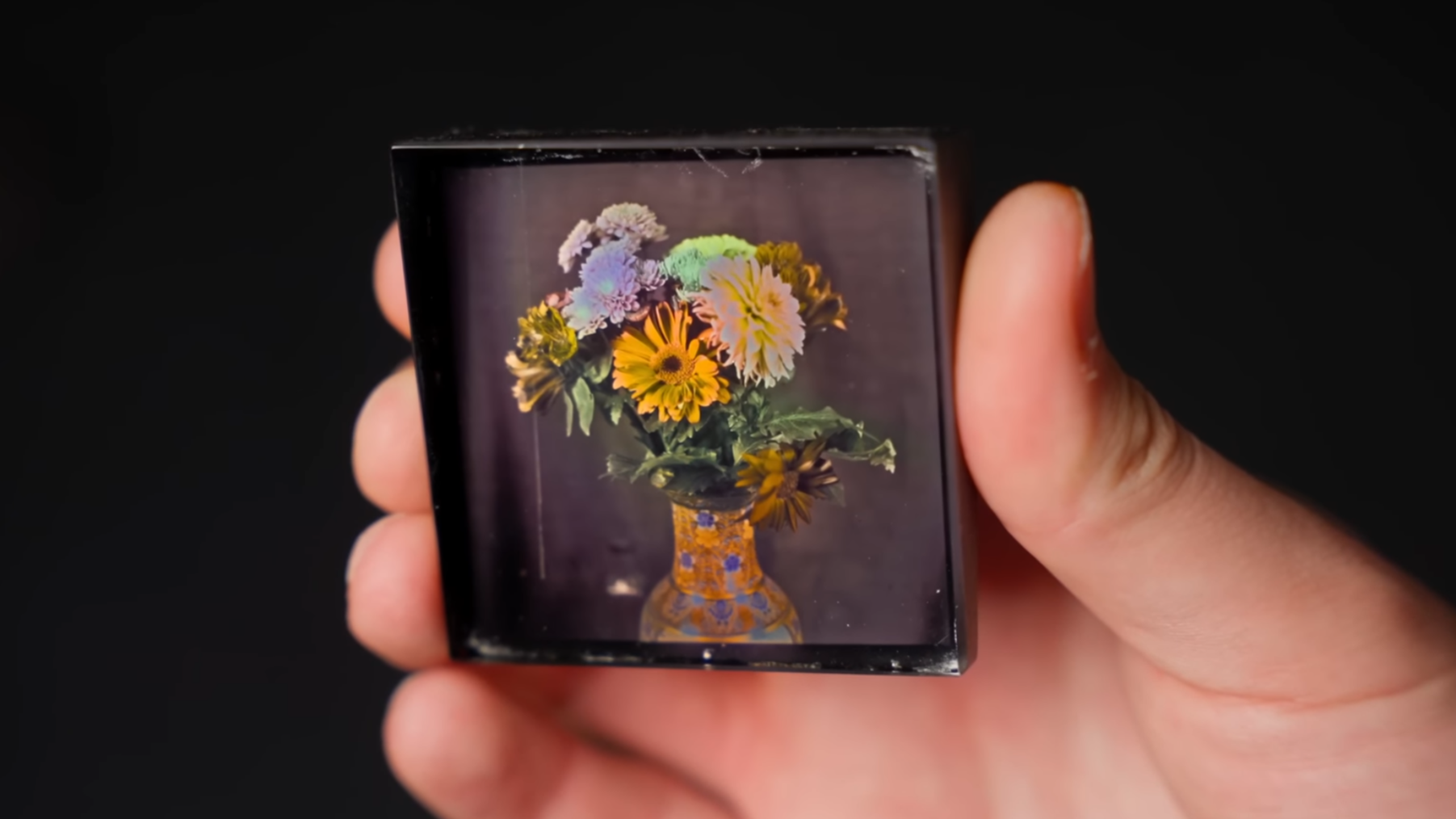
In 1891, Gabriel Lippmann unveiled a photographic process that bypassed the trichromatic shortcut entirely. His technique, known as the Lippmann plate, recorded the full wavelength information of light. Instead of using dyes or pigments, it captured light itself by creating a permanent interference pattern within the emulsion. The result was a photograph that, when viewed under white light, re-emitted the exact spectral composition of the original scene. It wasn't just a color image—it was a physical reconstruction of the light field, with no need for color filters or digital interpolation.
4. How a Lippmann Plate Freezes Light in Place
The construction of a Lippmann plate is as ingenious as it is delicate. A glass plate is coated with a transparent photographic emulsion containing incredibly fine silver halide crystals. During exposure, the plate is placed with the emulsion side against a mirror—traditionally a pool of mercury. Light passes through the emulsion, reflects off the mirror, and interferes with the incoming light, creating a standing wave pattern. The antinodes (peaks of the wave) receive the most energy, causing local silver halide crystals to develop into reflective silver particles. The spacing between these particles corresponds exactly to the wavelength of the original light.
5. The Role of Standing Waves in Color Capture
This standing wave interference is the heart of the process. When light is reflected back on itself, it forms a stationary pattern with fixed regions of high and low intensity. The distance between these regions is half the wavelength of the light. In the Lippmann plate, the silver grains collect precisely at the high-intensity antinodes. After development, these grains form a series of parallel layers—like microscopic mirrors stacked vertically. The spacing between layers is determined by the original color: red light produces wider spacing, blue light tighter spacing. This layered structure is what later diffracts light to reproduce the original hue.
6. Diffraction Gratings That Work from Any Angle
Unlike a conventional diffraction grating (which splits white light into its component colors at specific angles), the vertical stack of silver layers in a Lippmann plate behaves differently. Because the layers are parallel to the glass surface and spaced by the original wavelength, they act as a volume reflection grating. When white light strikes the plate, each layer reflects a narrow band of wavelengths. Thanks to the geometry, the reflected color remains consistent across a wide range of viewing angles—you don't get a rainbow shift as you move your head. This was a breakthrough, as it meant the colors appeared stable, much like a painting.
7. The Viewing Angle Trade-Off
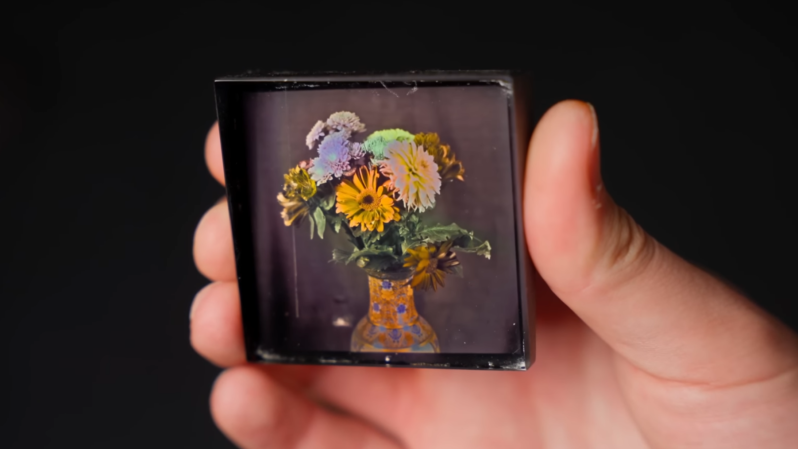
But stability came with a trade-off: the viewing angle itself was severely restricted. Unlike a dye-based photograph that you can see clearly from almost any direction, a Lippmann plate only displays its true colors when viewed nearly head-on. Tilt the plate even slightly, and the image fades or becomes dim. This limitation, alongside the delicate nature of the mirror-backed plate, made it impractical for everyday use. You couldn't hang a Lippmann plate on a wall and expect people to see it properly—they would have to look straight at it, one at a time, under ideal lighting.
8. Why Lippmann Plates Never Became Mainstream
Several practical drawbacks prevented Lippmann plates from becoming a commercial success. First, exposure times were extremely long—often minutes or even hours—making it impossible to photograph moving subjects. Second, the process was finicky: washed-out colors were common if the exposure or development wasn't perfect. Third, each plate was a unique original; no reprints or copies could be made. Finally, the mercury mirror was toxic and hazardous. By the early 20th century, simpler color processes like Autochrome (which used dyed starch grains) won the market, even though they sacrificed spectral accuracy for convenience.
9. The Hidden Legacy of Lippmann's Idea
Though Lippmann plates faded into obscurity, the underlying principle of recording interference patterns did not. It directly inspired the invention of holography in the 1940s and 1960s. Holograms also encode light as a diffraction pattern—only they capture phase and amplitude, creating three-dimensional images. Modern holographic displays, security features on credit cards, and even some optical data storage techniques owe a debt to Lippmann's work. His process lives on as a foundational concept in wavefront reconstruction, proving that an old idea can find new life long after it was deemed impractical.
10. Modern Takes on Structural Color Photography
Today, researchers are revisiting structural color for applications beyond photography. Lippmann plates are being studied for archival color imaging that never fades—since the color comes from physical structure rather than chemical dyes. Scientists are also exploring nanostructured surfaces that mimic the silver layers, creating vibrant, permanent colors without pigments. In a world obsessed with digital perfection, the old analog method offers a tantalizing glimpse of what true spectral fidelity could mean: images that capture not just the appearance, but the very essence of light. Perhaps the future of photography isn't in more pixels, but in more physics.
The journey from trichromatic approximations to full-spectrum capture reminds us that our tools shape our perception. Lippmann plates may never have gone mainstream, but their legacy persists in every hologram and every effort to push beyond the limits of human vision. True-spectrum photography challenges us to see the world more completely—and reminds us that sometimes, the oldest ideas are the most radical.